

Professional Casting Sessions at Affordable West London Studios
If you need efficient, professional casting without breaking the budget, this guide walks you through hosting casting sessions at affordable West London studios with a production-first approach. I’ll cover practical venue choices, a step-by-step run sheet, on-site technical setup, talent flow, and post-session follow-up so you can recruit, record, and hire with confidence.
The Barn venue hire for casting sessions
The Barn venue hire at Ravenor Farm Studios is a strong option when you want a private, characterful space that doubles as a filming set. Use it for in-person auditions, recorded screen tests, or small on-camera chemistry reads. Its open floor plan makes it straightforward to build temporary sets, arrange waiting areas, and keep sightlines clear for directors and DPs.
When you evaluate The Barn venue hire, plan your floor layout first: entrance/waiting, audition booth or set, camera/operator position, director/producer line, and a private green room. Clear circulation keeps rounds moving and reduces downtime between candidates.
Choosing the right West London studio and space
Start by matching your session needs to a venue’s capabilities. For casting you typically need: quiet sound conditions, reliable power and lighting, a camera zone, a director’s viewing spot, furniture for on-set props, and somewhere private for callbacks. Search venues that advertise production support or technical crew so you can avoid juggling operational tasks while you run auditions.
Use the following keywords and venue types in your searches and conversations with venue managers: workshop venue West London when you plan training or group auditions; brand launch venue London if the cast will be photographed on branded sets; private event venue London if you need privacy for high-profile talent; and event space hire West London if you require flexible open areas that can be dressed as a set.
Practical checklist for venue features
- Sound control: dedicated quiet rooms, double-glazed windows, or soundproofed booths.
- Power and rigging: enough circuits and safe overhead rigging points for lights.
- Access and parking: loading access for sets and nearby parking for crew and talent.
- Waiting and green rooms: separate, private space for candidates between slots.
- Internet and streaming: reliable upload bandwidth if you need remote casting or live feedback.
- On-site technical support: access to a technician for camera, audio, and playback issues.
Pre-production steps and run-sheet
Plan like a small film shoot. Break the day into clear segments and communicate timings to talent, casting staff, and crew.
Example run-sheet (adapt durations to your needs):
- 08:30 – Crew load-in and tech check: lights, camera, audio, playback.
- 09:30 – Doors open; registration and consent forms for candidates.
- 10:00 – Audition slot blocks begin (e.g., 10–15 minute slots per candidate).
- 13:00 – Lunch break and equipment check.
- 14:00 – Callback slots and director chemistry reads.
- 16:30 – Wrap: debrief, secure recorded files, backup media.
Always build buffer time between slots for overruns and technical resets. Have a production runner manage talent movement from waiting to audition and back to avoid director interruptions.
Technical setup that reduces risk
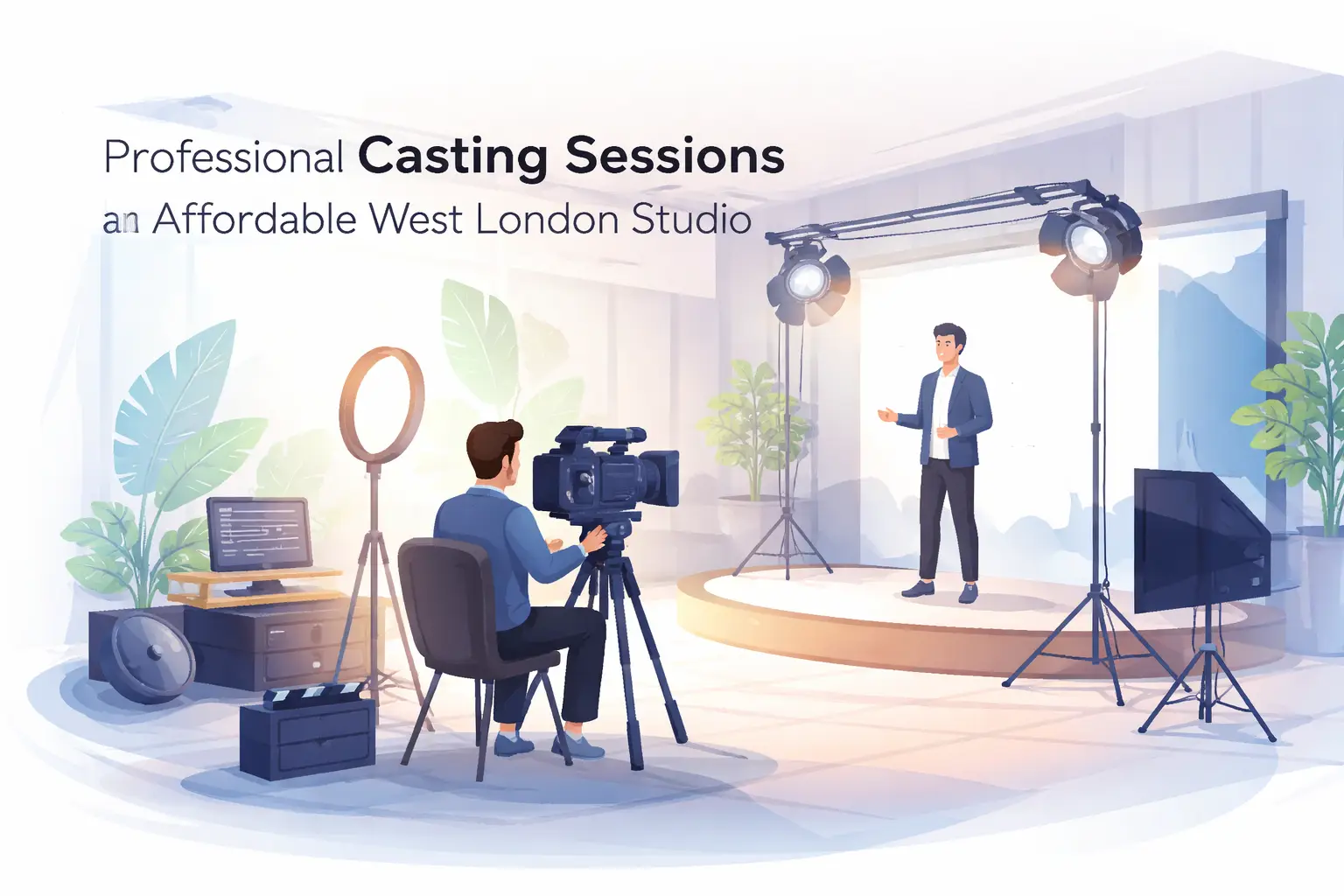
For recorded auditions, aim for consistent camera framing and clean audio. A typical minimal kit looks like: a stable camera on tripod with an interchangeable lens (for portrait or waist-up framing), a shotgun or lavalier mic per candidate, LED key light with soft diffusion, a small fill, and a neutral backdrop or dressed set. Record both camera masters and an isolated audio track to simplify editing and playback during callbacks.
Talent flow and on-day organisation
Small details control the candidate experience and speed. Send clear pre-session instructions covering arrival times, location details, ID or materials to bring, and whether they should prepare sides or monologues. On arrival, have signage and one check-in point. Use a tablet or spreadsheet for instant slot updates so everyone follows the same schedule.
During the audition, keep direction concise and consistent. Record a short slate (name, role auditioning for) at the start of each take to make the review process fast. For callbacks, set up a playback station so decision-makers can watch multiple takes back-to-back without disrupting the live schedule.
Health, safety and permissions
Confirm venue insurance and get written permission for filming and storing recordings. Ensure the venue holds appropriate public liability and production insurance for the activities planned. If you’re hiring minors, follow safeguarding procedures and have a chaperone present as required.
For guidance on legal and venue safety standards consult official government guidance; for example, venue safety and event management resources are provided by the UK government at www.gov.uk.
Post-session workflow to secure recordings and talent
Immediately back up media with a two-location rule: local SSD and a network copy or cloud upload. Label files with candidate name, slot time and role. Share a secure review link with decision-makers and set a clear deadline for notes to keep momentum.
Follow up with candidates politely—an automated email outlining next steps and expected timeline reduces queries and improves the candidate experience.
Pricing and bookings without surprises
Request an itemised quote that separates space hire, technical support, equipment, crew rates and optional extras such as catering or extended hours. Ask venues about their cancellation policy, overtime charges, and whether they provide a rehearsal or tech day at a different rate. If you want a compact primer on private creative events logistics, our event space hire West London Tips for Private Creative Events article covers similar planning steps in more depth.
Scenario planning with limited budget
If budget is tight, prioritise essentials: solid audio, reliable power and a quiet space over decorative lighting. You can simplify lighting by using a single soft key and a reflector, or reduce crew by hiring a studio that includes a technician in the hourly rate. Consider weekday daytime bookings for lower rates and more flexible availability.
Diagnosis and Action Checklist
- What is uncertain: exact venue maximum occupancy, fire safety certificates, insurance coverage, and technical capacity such as circuit availability and internet upload speeds.
- Where to look in official sources: search venue paperwork and local authority pages for “maximum occupancy”, “fire risk assessment”, “public liability insurance”, and “electrical safety certificates”; on gov.uk look for “event safety” and “film and TV production guidance”.
- Data to collect or tests to run:
- Ask the venue for their current fire risk assessment document and the certified maximum occupancy number.
- Request a copy of the venue’s public liability insurance and the policy number to verify with insurers if needed.
- Test on-site power: have the venue confirm available circuits and run a load test with your full kit before the day.
- Run an internet speed test on-site during peak hours to confirm upload bandwidth for remote casting or streaming.
- Ask for a site plan showing exits and loading access; walk the plan yourself with production staff.
- How to distinguish scenarios:
- If the venue provides up-to-date fire assessment and insurance documents and passes the power/internet tests, you can proceed without hiring additional safety consultants.
- If the venue lacks clear certificates or power capacity is insufficient, either request the venue remedy the issues in writing or move to an alternative space with verified documentation.
- If internet upload is borderline, plan to record locally and upload from a wired connection post-session or book a venue with guaranteed connectivity.
Case example and final tips
Scenario: a casting day for a short commercial requiring 30 on-camera slots plus callbacks. Book a studio that offers production support and an on-site technician so you only need two people to manage tech. Use The Barn for primary auditions and a smaller adjacent room as green room and callback editing area. Run continuous backups and share a secure review link to hiring stakeholders within 24 hours to keep the process moving.
Final tips: confirm logistics in writing, build buffer time, and pick a venue that advertises production support. If you want a studio that combines technical crew, discrete event spaces and multi-purpose sets, Ravenor Farm Studios offers flexible options that suit casting, podcasting and small-scale shoots—see our booking page or contact the team to arrange a walk-through. For more on studio hire and multi-camera setups, our article on Content Creation Studio West London for Multi-Camera Production is a helpful read.
Ready to plan a casting day? Prepare your brief, compile the checklist above, and reach out to venues early to secure the best dates and technical support.