

Commercial shoot studio and creative venue in West London
Ravenor Farm Studios blends flexible spaces and hands-on technical production support to help creators run professional shoots, workshops and events without surprises. Whether you need a compact podcast booth or a multipurpose studio for a product shoot, this guide explains practical hire options in West London, how technical support adds value, and the steps to book the right space for your production.
photography studio West London options and when to choose them
Choosing the right space starts with the creative brief. If your brief calls for controlled lighting, client viewing, or staged interiors, a photography studio West London venue with dedicated grip and lighting zones will save time on set. For on-camera interviews or content that needs a broadcast-ready signal path, consider a studio that also offers multitrack audio and live switching.
Common scenarios and the corresponding spaces available at a full-service hub:
- Small interview or podcast: private booth with acoustic treatment and multitrack capture.
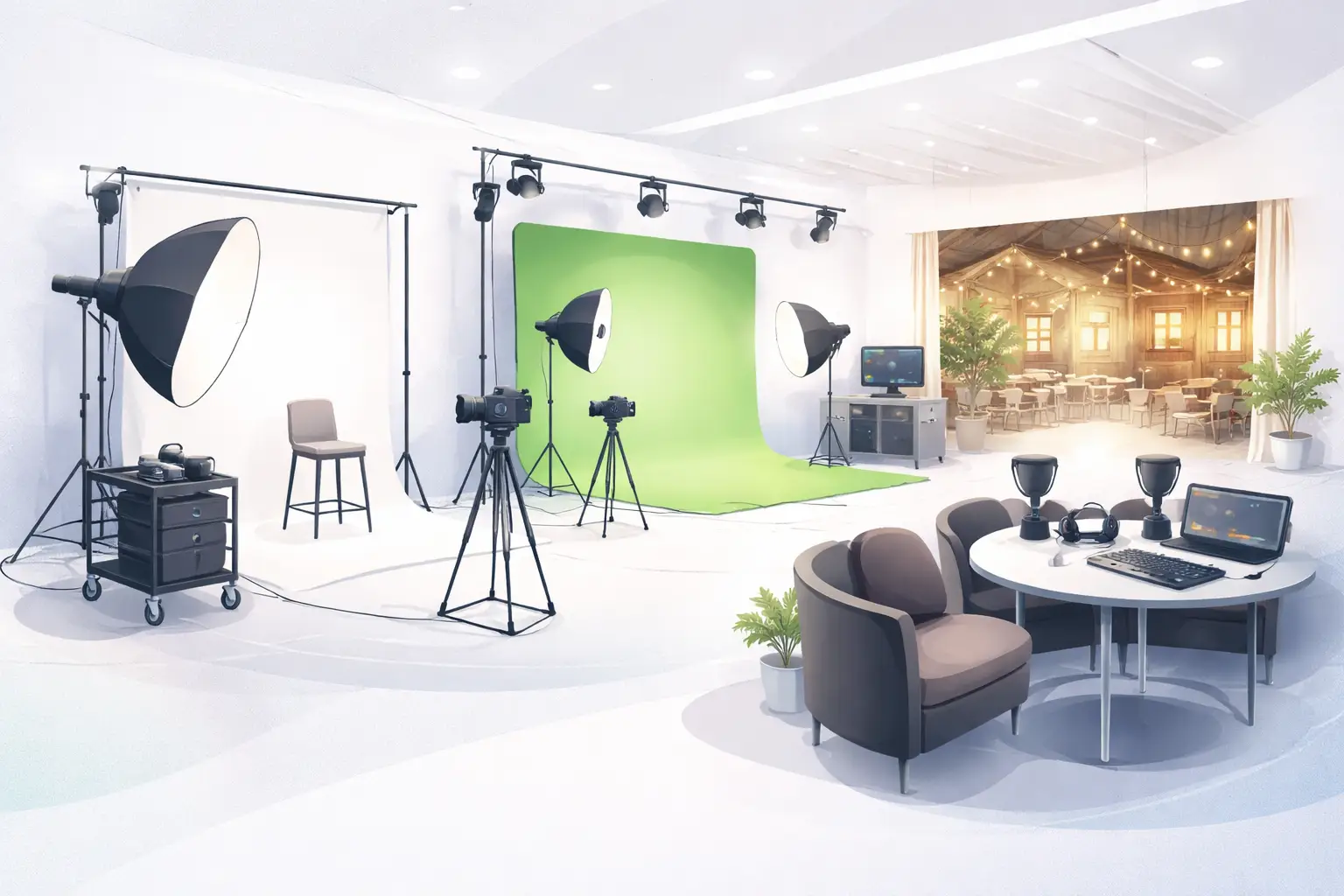
- Product or e-commerce photography: cyc wall or flexible backdrop area with pro lighting and tethering stations.
- Video shoots with guests and a live audience: a larger studio or The Barn venue with FOH technical support and audience seating.
- Live streaming and remote broadcasts: spaces provisioned for ISDN/streaming encoders and remote guest integration.
How dry hire production studio bookings work in practice
Many creators prefer a dry hire production studio model to retain control: you bring your crew and manage the shoot while the venue provides space, basic power and access. At Ravenor Farm Studios you can combine dry hire studio London access with optional technical packages—engineer-led setup, camera or lighting kit rental, and on-site crew for continuity.
When to choose full technical support versus dry hire only:
- Hire only the space if you have a seasoned crew and local kit.
- Add technical support if you need time-pressed setup, signal routing for live streams, or an operator for camera, audio or switching.
commercial shoot studio considerations for production teams
For a commercial shoot studio booking, check these production-critical elements before you confirm a date: power distribution and available amp circuits, rigging points for lights and backdrops, parking for vehicles and props, rehearsal time, and access to secure client holding areas. Ask whether the venue provides stagehands, a technical supervisor, or stage management for longer production days.
What equipment and technical support typically add most value
Technical production support transforms a booked studio into a professional shoot environment. Useful services include:
- Tech producer or stage manager to coordinate arrivals, cueing and continuity
- AV engineer for soundchecks, multitrack record and live mix
- Camera operator or remote camera control for multicam shoots
- Lighting tech for shaping scenes and matching colour temperature
- IT/streaming support to configure encoders, bandwidth checks and remote guest feeds
If you need specialised capture, ask about green screen workflows and chroma key prep: this often involves flagged lighting, background distances and test clips to verify spill and edge detail.
green screen studio hire tips for successful chroma key shoots
Green screen shoots are straightforward when the fundamentals are handled: even, shadow-free illumination of the backdrop, enough distance between subject and background, and camera settings tuned to avoid colour clipping. Bring or request a technical brief from the venue so the lighting team can prepare. If you plan compositing in post, request test footage from the venue to confirm the capture format and colour profile.
Booking scenarios with sample step-by-step plans
Below are three practical booking scenarios with step-by-step planning you can adapt.
Scenario A — 1-day product photography with client present
- Confirm studio access and client viewing area; request a floor plan.
- Book photography studio hire London with a dedicated grip kit and tether station.
- Request a lighting technician for the morning setup and a support assistant for changing sets.
- Schedule a half-hour handover and a 15-minute client viewing window between set changes.
Scenario B — Half-day podcast recording and livestream
- Book the podcast booth and request a multitrack recording and live stream patch.
- Arrange an audio engineer to manage levels and an IT tech to run the encoder.
- Run a 30-minute rehearsal with a remote guest to test the feed and latency.
- Confirm recording formats and file delivery method for post.
Scenario C — Workshop and evening screening in The Barn
- Reserve The Barn for the day and evening; confirm seating layout and blackout options.
- Book a technician for AV set and projector calibration; request cabling plans for guest presenters.
- Schedule a technical rehearsal with all presenters and a soundcheck before doors open.
- Ensure signage and stewarding details are agreed with the venue team.
Pricing, insurance and practical admin to prepare before you arrive
Venues typically request proof of public liability insurance for large events and productions. Prepare a brief booking email that lists crew names, load-in times, kit inventory and any required risk assessments. Ask the venue for their insurance requirements and any venue-specific terms so you can arrange cover or provide evidence ahead of the shoot.
For live broadcasts check the venue’s internet uplink: technical staff should perform a bandwidth test and, where possible, bring a backup connection or failover plan. A pre-shoot technical call with the venue team reduces surprises and clarifies handover responsibilities.
On-the-day checklist for production managers
- Confirm parking and load-in point with venue contact.
- Run a walk-through on arrival to note power outlets, light rig points and safety exits.
- Label and photograph installed cable runs and equipment positions for continuity.
- Perform camera, audio and lighting tests in real production conditions.
- Document any venue-supplied kit and its operating notes for post-shoot handover.
Diagnosis and Action Checklist
This checklist helps you resolve common uncertainties when evaluating a studio or venue listing.
- What is uncertain: exact technical specs that affect your shoot (power capacity, rigging points, acoustic treatment, available bandwidth, insurance limits, and kit inventory).
- Where to look in official sources: search the venue’s technical rider or facilities page for terms such as “power”, “rigging”, “acoustic”, “bandwidth”, “insurance” and “kit list”. If available, review the PDF technical rider or studio spec sheet.
- What data to collect or tests to run:
- Record the quoted maximum amp or wattage per circuit and the number of dedicated circuits.
- Request photographs or a diagram showing rigging points and ceiling heights; measure distances where green screen separation matters.
- Ask the venue to run a live bandwidth test (upload/download) and provide a screenshot with timestamp.
- Request a current kit inventory with serial numbers or model names for cameras, mixers and mics.
- How to distinguish likely scenarios:
- If the venue provides a detailed technical rider and kit list, you can proceed with confidence and plan integration tests with your engineer.
- If key specs (power, rigging, bandwidth) are missing, schedule an on-site technical visit or a remote video walk-through to verify.
- If the venue confirms constraints (single circuit, limited rigging), adjust your production: reduce lighting load, use battery-powered gear, or add an external power supplier.
- Recommended official sources: venue’s technical rider or facilities PDF; operator’s safety documents; a national safety regulator or government guidance for large events (for example https://www.hse.gov.uk) when assessing rigging and electrical safety; professional equipment manuals from manufacturers for compatibility checks.
How Ravenor Farm Studios supports bookings and what to ask when you enquire
When you contact the studio, have these items ready to speed up planning:
- Brief (format, duration, number of crew and guests)
- Preferred dates and load-in/out windows
- List of critical kit that must be supported by venue power or rigging
- Any streaming or broadcast delivery requirements
Ravenor Farm Studios offers tailored production support packages that can be layered onto a dry hire studio booking—technical supervision, AV operator, camera crews or full production coordination—so you can scale services to the complexity of your shoot.
For inspiration and location details, see The Barn creative venue post about larger events and screening setups on the Ravenor Farm Studios blog: video production studio London at The Barn West London
If you want to compare green screen setups specifically, Ravenor Farm Studios has a post on green screen options here: Podcast Recording Studio West London with Green Screen
Next steps and how to book a tour
1) Prepare your brief and preferred dates. 2) Request a technical call and, where helpful, an on-site walk-through. 3) Ask for a sample technical rider and any crew facilities notes. 4) Book a conditional hold while you confirm crew and kit. A short tour clarifies access, parking and the practical layout, and helps finalise a production day plan.
Ravenor Farm Studios positions itself as a production-focused, affordable West London hub for podcasters, filmmakers and brands who want reliable spaces and on-site technical expertise. Reach out with your brief to arrange a bespoke quote and a studio tour.