


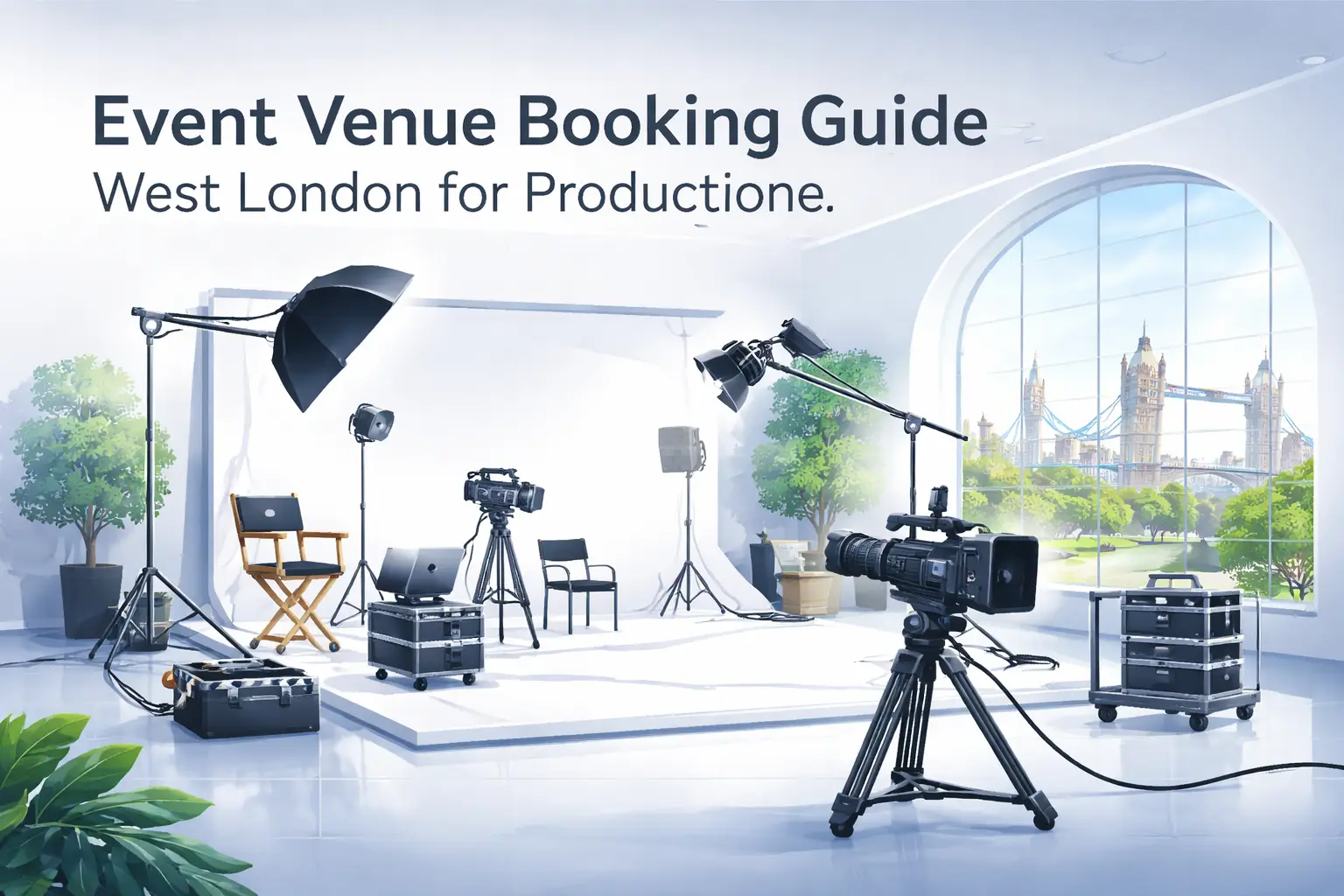
Event Venue Booking Guide West London for Productions
Booking a multifunctional event venue in West London for a production or content shoot demands more than a calendar check. This guide walks production managers, producers, and creative leads through the practical considerations that reduce risk, speed setup, and keep a production on schedule. It blends site-planning, technical checks, crew logistics and contract checkpoints into a step-by-step approach you can apply whether you are delivering a live event, a hybrid conference, a product shoot or a music video.
Start with the production brief and venue fit
Begin by translating your production brief into concrete venue requirements. List must-haves and nice-to-haves across these categories: capacity and layout, load-in access, power and rigging, acoustic profile, internet reliability, green room and catering space, and permitted hours for setup and strike. A clear list lets you screen venues quickly and keeps negotiations focused.
- Capacity and layout: map headcount, seating, standing zones, and camera sightlines to the floorplan.
- Load-in and access: confirm vehicle access, door dimensions, and onsite dollies or forklift availability.
- Tech and power: identify distribution points, generator space and dedicated circuits for camera and lighting rigs.
- Facilities for crew: secure rehearsal space, green rooms, lockers and secure kit storage.
Preparing for social media video production London at the venue
If your shoot is focused on short-form content or influencer-led output, venue choice affects turnaround. For social media video production London you want rapid turnaround for shooting, simple lighting rigs adaptable to vertical and horizontal framing, and easy backstage access for wardrobe and props. Ask whether the venue supports fast load-ins, has flexible blackout options and whether basic craft services are included or available on request.
Practical checks for fast content shoots
- Confirm daylight control (blackout curtains, controllable windows) for consistent exposure.
- Test entry routes for quick scene changes and safe transit of small sets or furniture.
- Ask about onsite storage for props between takes and overnight security options.
Power, lighting and technical infrastructure
Technical constraints are often the gating factor on a booking. A venue that looks suitable on paper can slow a production if it lacks adequate power, rigging points or safe load-bearing structures. For commercial video production London and film shoots you should confirm the number of usable circuits, access to three-phase power, dimmer availability and rigging points for lights and microphones.
Bring your tech rider to the site visit. Walk every camera position and note nearest power outlets, cable runs and potential trip hazards. Where required, plan a temporary power distribution scheme and identify a safe generator position outside the venue footprint if mains capacity is limited.
Sound, acoustics and noise management
Acoustics affect both location sound and the live event experience. For film and TV production London projects expect to assess reverberation times, background noise sources (traffic, HVAC, trains) and any local noise restrictions. If you need controlled sound, confirm whether the venue supports sound blankets, temporary baffles or small ISO booths for voiceover and ADR, and whether neighbours or venue management impose curfews.
Crew logistics and on-site workflow
Efficient crew movement reduces shoot time and budget pressure. Map arrival times, parking permits, catering schedules, and waste management in advance. Create a single-sheet contact list that includes the venue manager, technical contacts, security, nearest hospital and the production health and safety lead.
Amenities and accessibility
- Confirm disabled access and accessible toilets for any crew or attendees who need them.
- Check for changing rooms, makeup stations and secured backstage spaces for equipment.
- Verify washroom counts against expected headcount to avoid delays during breaks.
Permissions, licences and compliance
Licensing and planning constraints can change what you can do at a venue. Typical items to verify include the venue’s premises licence for public performance, alcohol licensing if relevant, permissions for amplified sound, temporary structure approvals and any special conditions the venue must follow. For live broadcasts and events, ask whether the venue has experience with broadcast OB units and whether they can accommodate an OB truck or external camera cranes safely.
Insurance, contracts and deposit terms
Clarify insurance requirements early: many venues require the hirer to carry public liability and equipment insurance. Review contract clauses that concern cancellation, overtime rates, damage liabilities and force majeure. Ensure the agreement defines load-in and load-out windows, strike deadlines and the responsibility for venue cleanup.
Post-production and nearby facilities
Booking a venue near post-production facilities can cut turnaround times for larger shoots. Ask whether the venue has recommended partners for post production services London and, for photography-heavy days, contacts for product photography studio hire London. If your schedule needs same-day editorial or colour grading, confirm logistics for fast transfer of media to your post team.
Ravenor Farm Studios operates with production handoffs in mind and can connect clients to local teams when required. If you are working with a video production company London or a film production company London, coordinate delivery specifications (codec, timecode, slate practice) before the shoot so files move seamlessly into post.
Loading, parking and transport
Confirm the venue’s loading bay dimensions, permitted vehicle weights and any parking restrictions for vans and trucks. For heavy or multiple vehicle setups, plan a dedicated marshal to manage traffic flow and maintain clear access for emergency services. When flying in talent or crew from Central London or Heathrow, map realistic travel times and build cushion into your schedule for delays.
Sample step-by-step booking scenario
Imagine a two-day hybrid product launch with live streaming, filmed interviews and social clips. A compact step plan:
- Day 1 — Pre-visit: circulate the production brief and tech rider to shortlisted venues; request floorplans and photos of rigging points.
- Day 2 — Site visit: walk all camera and audience sightlines, measure entry doors, test power points and run an internet speed test at peak hours.
- Day 3 — Technical planning: produce a power and network diagram, assign safe rigging positions and confirm staging and seating layouts.
- Day 4 — Contracts: confirm insurance documents, agreed load-in/out times and cancellation terms; secure the booking with a signed agreement.
- Pre-show — Run a technical rehearsal on site covering streaming ingest, backup connectivity and camera positions.
Relevant internal resources
For venue hire and studio-focused prep you may find these practical reads useful:
- Filming Location London Guide for Studio Hire in Greenford
- Studio Hire Greenford for Content Creation and Production
- Photography Studio Hire London Guide for Perfect Shoots
Diagnosis and Action Checklist
- What is uncertain: local licensing limits (e.g., noise curfew, maximum occupancy), precise electrical capacity, planning permissions for temporary structures, availability of on-site power distribution, internet bandwidth stability, and parking/vehicle weight limits.
- Search in official sources for these exact words/sections:
- “premises licence” or “premises licence conditions”
- “maximum occupancy” or “fire safety certificate”
- “planning permission” and “temporary structure” or “event structure”
- “noise abatement” or “noise nuisance guidance”
- “electrical supply” or “three-phase power” or “temporary power supply”
- “public liability insurance requirements” and “venue hire insurance”
- Data to collect and tests to run at the site visit:
- Obtain an official floorplan with labelled doors, windows, rigging points and fixed services.
- Take photographs of load-in routes, door widths and ceiling heights; measure critical dimensions with a tape measure.
- Request the venue’s electrical distribution layout and confirm breaker sizes; bring a multi-plug tester for quick continuity checks if allowed.
- Perform an internet speed test during the venue’s busiest advertised hours and at the proposed setup location.
- Record ambient noise levels during the time you plan to shoot (smartphone apps can provide dB estimates for comparative purposes).
- Confirm the venue’s insurance certificates and ask for a standard hire contract to review cancellation and indemnity clauses.
- Which official sources to consult:
- Local council websites for planning and licensing (search the council’s licensing or planning pages).
- Environmental Health or Noise Nuisance pages on the local authority site for curfew rules.
- UK Government guidance for event safety and temporary structures (for legal/regulatory context).
- Venue-provided documents such as fire risk assessments, electrical test certificates and insurance schedules.
- Industry guidance from recognised bodies or trade associations for live events and production safety.
- How to distinguish multiple scenarios:
- If the venue provides a valid premises licence explicitly permitting amplified music beyond your required hours, proceed with a booked risk assessment. If no licence exists, you must either change event hours or secure a Temporary Event Notice where applicable.
- If electrical supply documentation shows single-phase only and your rig requires three-phase, either bring a generator or select a venue with confirmed three-phase capacity.
- If internet tests show sub-acceptable speeds during peak hours, plan a bonded cellular solution or a dedicated line; confirm on-site routing for a bonded unit.
- If planned vehicle access is restricted by weight limits or narrow roads, arrange off-site parking with shuttle logistics or choose an alternate venue with confirmed heavy vehicle access.
Final checklist before confirmation
- Run a full tech walkthrough with department heads and the venue technical contact.
- Confirm signed insurance certificates and exchange contact details for day-of production.
- Lock in load-in/out windows, forklift or ramp availability and on-site power layout.
- Agree contingency plans for weather, power loss and last-minute schedule changes.
Well-executed venue selection reduces downstream problems on set and speeds the path from shoot day to finished content. Treat the site visit as a technical rehearsal — bring your measurements, your tech rider and a checklist — and you’ll turn a promising space into a reliable production environment in West London.