


Podcast Studio London Guide for West London
Hiring a studio in West London for a podcast involves more than booking a room. This guide walks you through the top features to prioritise, illustrated with practical scenarios and step-by-step checks so you can judge studios quickly, reduce risk and ensure a smooth production day.
Assessing podcast studio London in West London
When scouting a podcast studio London, imagine three common scenarios: a one-hour interview with minimal crew, a multi-guest roundtable that needs multiple mics and cameras, and a live-streamed show with remote callers. Each scenario places different demands on equipment, acoustics and crew. Use the scenarios below to compare studios on concrete capabilities rather than promises.
Scenario 1 — Simple interview session
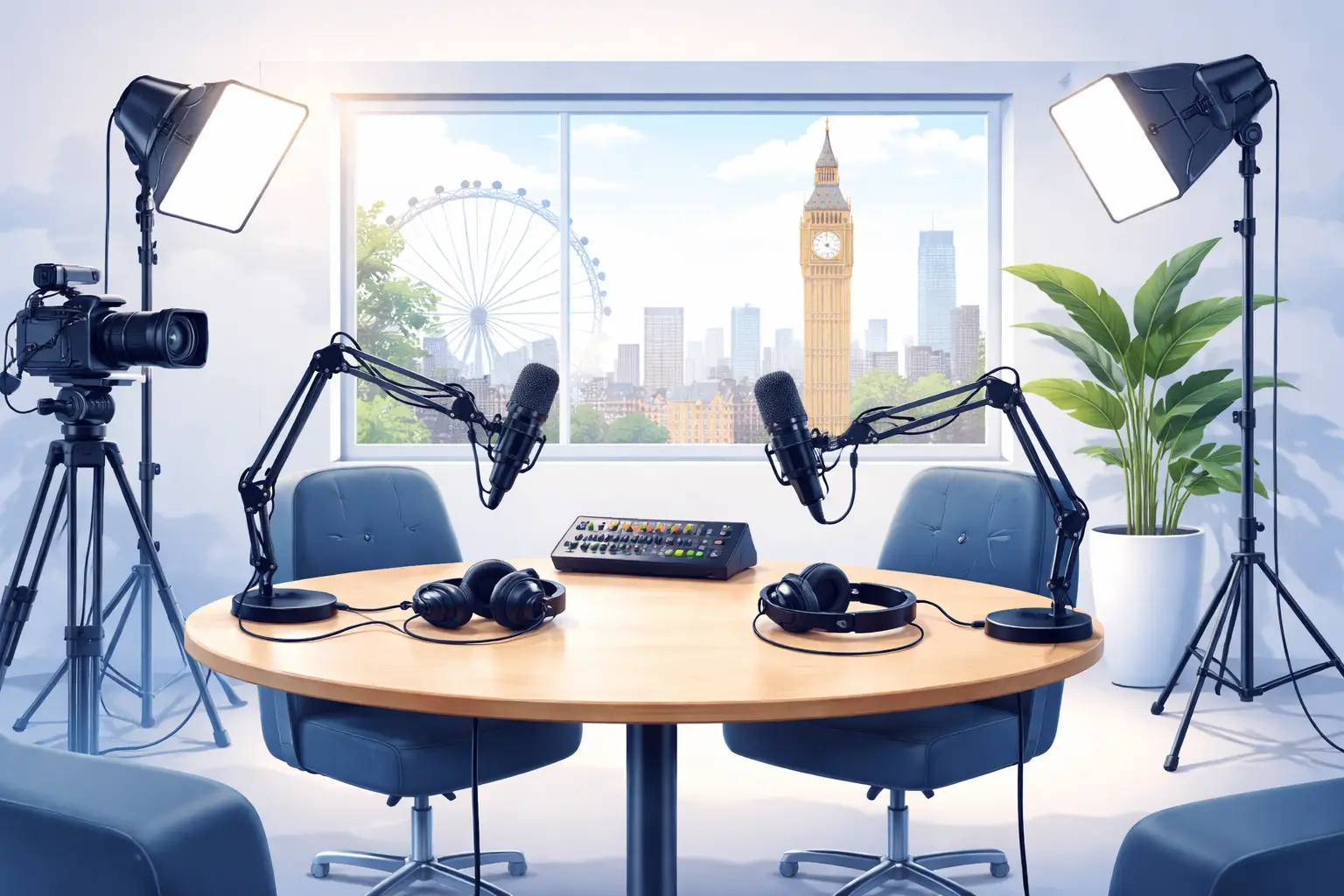
Checklist highlights: reliable quiet room, at least two cardioid microphones with shock mounts, basic headphone monitoring, and a technician who can patch a phone call. Confirm there is a desk or table with comfortable seating and stable mic stands so your host and guest can focus on the conversation.
Scenario 2 — Multi-guest and video capture
If you plan to record video as well as audio, consider a space set up for multi-camera shoots and simple lighting rigs. Many creators look for a single booking that covers both podcast and video needs; mention “video capture” early so the studio brings appropriate stands, cameras and sync workflows. Studios marketing themselves as production studio hire London are often already configured for combined shoots.
Scenario 3 — Live-streamed episode with call-ins
Prioritise stable internet, a dedicated streaming machine or encoder, and a technician experienced in live switching. Ask to see examples of past live productions and whether the studio supports remote guest integration tools you already use.
Key technical and practical features to inspect
Below are the feature areas that make the biggest difference on shoot day, with practical steps you can follow during a tour or test booking.
- Acoustic environment — Listen for background noise (traffic, HVAC hum, footsteps). Ask whether the space has dedicated acoustic treatment rather than just soft furnishings.
- Microphones and monitoring — Confirm mic models, spare capsules, headphone amplifiers and how many simultaneous headphone mixes the studio can provide.
- Recording chain and backup — Verify the recording interface, backup methods (hardware or redundant recorders) and file formats delivered after the session.
- Connectivity — Test the wired internet connection. For live work, ask whether the studio provides an isolated network and the router configuration used for streaming.
- Power and stage management — Check for dedicated ring-main outlets and labeled power distribution. For multi-equipment days, confirm available circuits and onsite support for power distribution.
- Lighting and camera support — If you need video, inspect available cameras, tripods, and lighting. A studio that offers photography studio London or TV studio London services often has flexible lighting packages.
- Technical staff and operator experience — Request CVs or a brief list of recent productions the technicians have supported. Experienced staff reduce setup time and troubleshooting during the session.
- Accessibility and logistics — Consider parking, loading access, proximity to public transport and nearby facilities for guests and crew. For West London locations, factor in travel times from Central London and Heathrow.
- Flexible hire options — Confirm dry hire availability and what is included in a standard booking. Studios that advertise content studio hire London or production studio hire London usually list dry hire policies and included gear.
- Insurance and contracts — Ask what the studio’s public liability and equipment insurance covers, and request the standard hiring contract to review cancellation and overtime terms.
Onsite checks and test recording routine
Run this short test during a tour or a paid trial hour. It reveals practical differences that spec sheets don’t show.
- Do a walk-and-listen: note intermittent noises at different times of day.
- Record a short test: two voices, two mics, 60–90 seconds. Listen for room coloration and bleed.
- Check headphone mixes: confirm each talent can hear themselves and the feed without latency issues.
- Test file delivery: ask for the test files via the studio’s normal transfer method so you can confirm transfer speed and file naming conventions.
- Verify camera sync and timecode if recording video: perform a clap and check audio-to-video alignment in a quick edit.
Staffing, turnaround and post production
Ask whether the studio includes basic editing, stem mixing, or full post-production. Some studios offer a la carte services while others include a simple editing pass. If you need faster turnaround or custom edits, confirm rates and delivery timelines in writing. For production companies and creators who require broader services, a facility that positions itself for content studio hire London often provides a menu of post options—ask for examples and delivery samples.
Budgeting and booking strategy (without rates)
Rather than focusing on price during initial contact, frame your questions around what is included and what is extra. For example, ask whether engineer hours, setup time, and clear-up are part of the booking window, and whether additional rehearsal or overtime is charged separately. A clear booking policy prevents surprises and helps you compare studios on total value rather than headline price.
If you will be producing other types of work—photography, music video or TV segments—look for a studio that lists photography studio London, TV studio London or film studio London services so equipment and crew experience translate across formats.
Using internal resources and case references
If you want a deeper look at production options and dry hire flexibility in West London, review facilities that explain benefits for creators. For production-oriented hires, see a detailed overview of production studio hire West London benefits and for dry hire options check a guide on dry-hire studio advantages for creatives in West London. If you need green screen capability for hybrid shoots, consult resources that explain green screen fit-outs for professional video.
Production studio hire West London benefits
Dry hire studio advantages for creatives in West London
Green Screen Studio Hire London for Professional Video
Diagnosis and Action Checklist
- What is uncertain
- Exact acoustic performance and whether the room meets your production quality needs.
- Network reliability and upload bandwidth for live streaming needs.
- Precise equipment models, spare inventory and backup recording strategy.
- Insurance coverage relevant to your production and contract-specific clauses (cancellation, overtime).
- Where to look in official or authoritative sources
- Search the studio’s technical rider or spec sheet for explicit model names and backup procedures.
- Check the studio booking contract for headings such as “Liability”, “Insurance”, “Cancellation”, “Overtime” and “Inclusions”.
- For electrical safety and PAT testing, look for documented certificates and terms referencing UK electrical safety or the studio’s compliance statements.
- For acoustic standards or measurement reports, search for terms like “ISO 16283”, “ISO 354”, “acoustic report”, “RT60 measurement” in the studio documentation.
- Data to collect and tests to run
- Obtain the studio’s equipment list and record the exact model numbers for microphones, interfaces, mixers and recorders.
- Request recent sample recordings or session stems from similar setups (multi-guest, live-stream, video + audio).
- Run a short test recording on-site: two voices, two mics, 60–90 seconds. Save the raw files and check for noise and bleed.
- Measure upload/download speed via a wired connection during the time you expect to stream.
- Ask for copies of the studio’s insurance certificates and any PAT or electrical safety certificates.
- Photograph cable runs, power distribution and mic placements so you can plan setup or flag hazards.
- How to decide between likely scenarios
- If test audio shows low background noise, consistent mic levels and clear headphone mixes, the space is suitable for standard interviews and podcasts.
- If test audio reveals room coloration or echo that affects voice clarity, request additional acoustic treatment or consider a different room; compare with other studios’ test results.
- If upload bandwidth is insufficient or inconsistent during your live-stream test, either arrange for a wired private line or select a studio that offers dedicated streaming infrastructure.
- If the studio cannot produce equipment spec sheets or insurance proofs on request, treat that as a red flag and prioritise vendors that provide full documentation before booking.
Final steps before you book
Confirm a short paid test or rehearsal in the exact configuration you will use on the production day. Get a written list of included items, engineer hours, and the expected delivery format for recorded files. If you expect to return frequently or require multi-format shoots, negotiate a repeat-booking arrangement or package that clarifies turnaround and storage policies. Choosing a studio with transparent documentation and a willingness to run a test day reduces risk and saves time on the production day.
Ravenor Farm Studios sits in West London and positions itself to support creators who need versatile spaces for podcasting, photography, TV and film production. Treat your studio tour as a technical interview: bring your scenario, run tests, and compare outcomes. That practical approach is the fastest way to select the right studio for your project.