


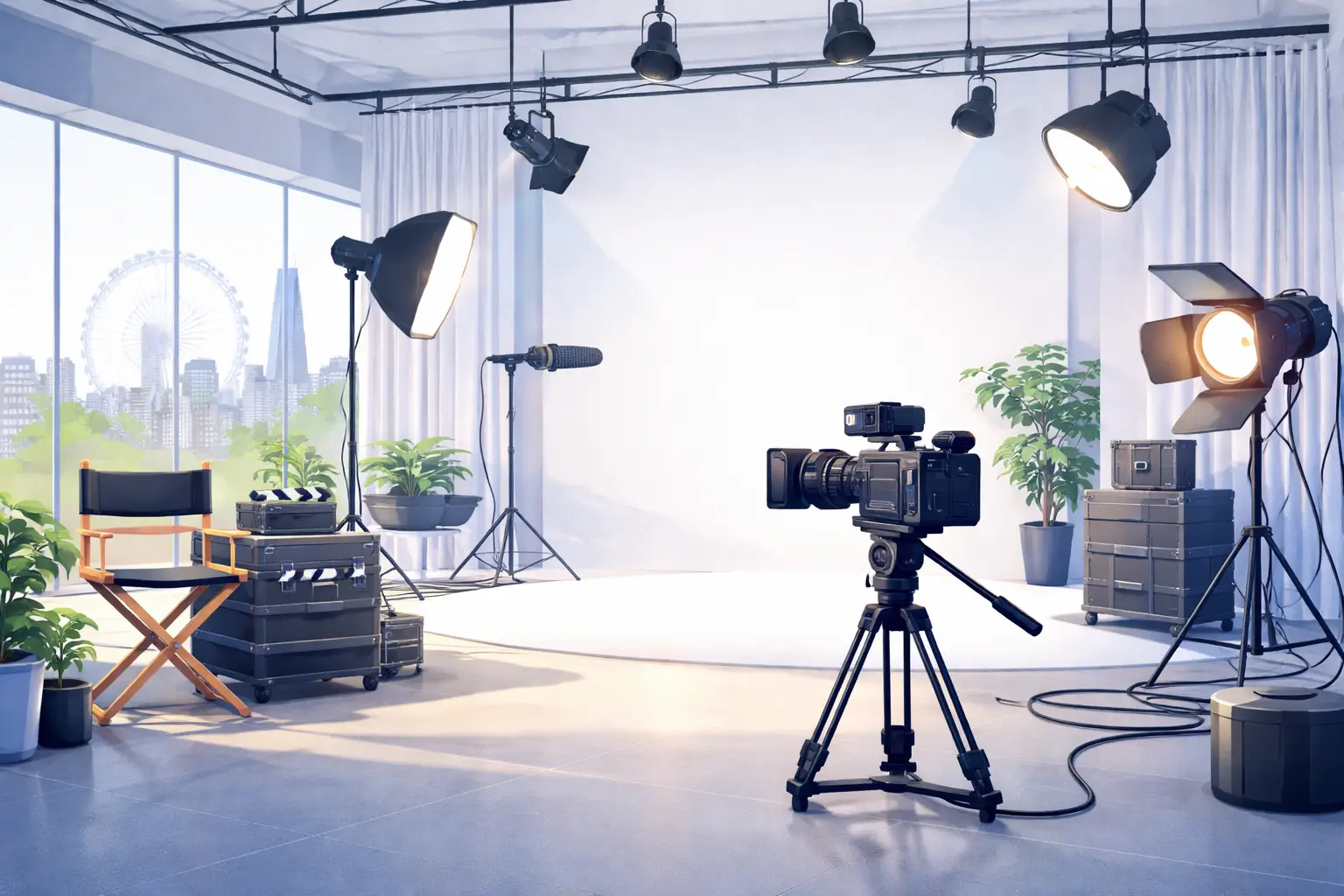
Studio Space Guide for Film and TV Production London
Choosing the right studio for your next London shoot determines how smoothly your production runs and how much of your budget is spent solving problems on the day. This guide walks you through practical, scenario-based decisions—from prep and site visits to technical checks and on-day flow—so you can pick a space that fits your script, crew and equipment, then convert that fit into confirmed bookings.
Start with the production scenario
Frame your search in concrete terms. Are you shooting a green-screen spot with a small crew, a 2-day music video with live performance elements, a branded commercial with multiple set builds, or a multi-day TV drama block? For each scenario list: cast and crew headcount, kit list, set build size, and turn-around requirements. These four items drive the studio size, load-in, power and studio-day scheduling you need.
- Example: a 10-person crew + three talent + car prop will require a different floor loading and drive-in access than a solo interview rig.
- Example: require a fixed blackout for night exteriors? That affects wall finishes and door sealing.
film and TV production London studio requirements
When you plan for film and TV production London, focus on these physical and operational requirements: clear studio area (m²), ceiling height, rigging points, load-bearing floor capacity, dedicated power circuits, and isolation from noise sources. Ask for floor plans and technical specifications early; a measured plan prevents mis-matched expectations on kit and staging day.
Key spatial and technical checks
- Measured clear space and usable working area (not gross footprint).
- Ceiling height and rigging grid details—can your lighting grid or set gantry be safely installed?
- Power capacity: number of circuits, single- and three-phase availability, and distribution points.
- Loading: vehicle access, ramp, loading bay and hours for deliveries.
- Sound isolation: nearest noise sources, available quiet hours and whether ADR-friendly rooms exist.
Match production services to the space
Decide whether you need full-service or dry-hire. If you expect to use an outside team for finishing, verify availability of post production services London at or near the studio. If your shoot requires rapid turnaround for social channels, check if the facility supports social media video production London workflows—fast ingest, simple edit bays, and on-site encoder support for live deliverables.
If you are a brand or agency producing ads, confirm that commercial video production London teams have previously worked at the facility or that the studio supports external production companies and their vendors.
Kit rental and technical support
List every critical item and ask the studio whether it can supply or accommodate it: camera and lens packages, grip and lighting, generators, wireless links, video village monitors, talkback and intercom. Confirm whether the venue allows third-party vendors and whether an in-house technical team can assist with setup and troubleshooting. For many shoots, having a reliable video production company London contact who knows the space reduces time lost to configuration problems.
Location, travel and logistics
West London locations like Greenford offer fast access to Central London and Heathrow. For crew and equipment routing consider:
- Proximity to main roads and secure loading—minimise shuttle time between storage and set.
- Parking or transit allowances for trucks and crew vehicles.
- Nearby accommodation for multi-day shoots and time-of-day shoot constraints (early load-ins or late wrap-outs).
Where possible, time a site visit during a typical weekday load-in to see access patterns. If your shoot uses large props or vehicles, verify turning circles and gate clearances in person.
Power, HVAC and environmental control
Studio power failures or insufficient headroom cause the largest on-day delays. Ask for electrical load sheets and test points. Confirm HVAC capacity for full load scenarios: heavy lighting rigs increase ambient heat and may require extra cooling or duty cycles that affect sound isolation. If you need sustained generator use, check emission rules and placement for safe exhaust routing.
Health, safety and permissions
Make health and safety part of pre-production. Request the studio’s risk assessments, method statements, and proof of public liability insurance limits. Confirm whether the studio holds any permits for special effects, smoke or pyrotechnics and if local council notification is required. For shoots with stunts or pyrotechnics secure qualified supervisors and plan for rehearsals in a controlled area.
On-site amenities that matter
Small comforts speed days: secure green rooms, catering access, kitchenette, make-up and hair spaces, wardrobe racks and a rehearsal area. Also confirm internet bandwidth for live streaming or fast file transfers—if your shoot needs live deliverables, ask if the studio supports content creation studio London workflows with adequate upload speeds and wired network points.
Scheduling, buffer time and booking terms
Always build buffer time into your hire: load-in/load-out, set build, camera tests, and contingency for bad weather or technical delays. Review booking terms on overtime rates, cancellation policy and insurance requirements. If the studio offers flexible dry hire, check minimum booking blocks and whether successive days can be reserved at a preferential rate for longer shoots.
Site visit checklist and sample questions
Use a concise checklist on your site visit and ask the venue to demonstrate key items: power panel operation, rigging points, loading procedure, and internet test. Take photographs and annotated measurements and share them with your technical team to confirm fit.
- Bring a tape measure, laser distance tool, and a simple power meter reading device or a list of your highest draw items to calculate total load.
- Request an empty walkthrough to visualise set placement, camera angles and audience sightlines (if relevant).
- Capture exact door widths and gate timings for vehicle access.
When to use Ravenor Farm Studios for your West London shoot
If you need flexible studio spaces that support film and TV shoots, podcasting, product photography or live streams, Ravenor Farm Studios offers a combination of technical support and location convenience between Central London and Heathrow. For photographers, check options for product photography studio hire London; for content teams, the venue can support content creation studio London workflows and fast turnarounds.
Read more about practical studio hire options for live production and content creators in our guide to Studio hire Greenford for live streaming and content creators and discover specific tips for podcast bookings in Podcast studio Greenford practical tips to maximise your hire. If you are scouting a studio for photography, see photo studio hire London at Ravenor Farm Studios West London.
Practical booking workflow
- Define the production scenario and required kit list.
- Shortlist studios by measured space, power and access.
- Arrange a site visit with technical contact and perform the site checklist.
- Ask for written technical specs, floor plans and a quoted schedule including buffer time.
- Confirm insurance, risk assessments and any council notifications if necessary.
- Book a provisional hold, distribute a production schedule and confirm final numbers 7–14 days before the shoot.
Diagnosis and Action Checklist
This checklist helps you convert unknowns into verified facts before booking.
- Uncertain item: Exact usable clear floor area
- Search terms in official source: “floor plan”, “clear span”, “internal dimensions”.
- Data to collect: measured width, length, and any columns or obstructions; annotated photos from three angles.
- Test to run: tape or laser measure a proposed camera position and set footprint on-site.
- Decision rule: if measured usable area < planned set area + 20% working margin, reject or request alternate space.
- Uncertain item: Power capacity and distribution
- Search terms in official source: “electrical supply”, “single phase”, “three phase”, “kVA”, “distribution board”.
- Data to collect: number of circuits, amperage per circuit, distance from distro to stage and photos of breaker labels.
- Test to run: ask studio to demonstrate live panel read or provide stamped power schedule; bring a list of highest draw items to calculate expected draw in amps or kW.
- Decision rule: if calculated draw exceeds available kVA by project margin, arrange additional distro or on-site generator.
- Uncertain item: Sound isolation and external noise
- Search terms in official source: “sound insulation”, “noise levels”, “noise impact”, “quiet hours”.
- Data to collect: current nearby noise sources (rail, road), recorded noise samples during intended shoot hours, and studio isolation specs.
- Test to run: visit at planned shoot time and record five-minute audio clip; review with sound recordist.
- Decision rule: if ambient noise exceeds the production’s acceptable noise floor, secure alternative studio or limit recording times.
- Uncertain item: Load-in logistics for vehicles/props
- Search terms in official source: “loading bay”, “service entrance”, “vehicle access”, “opening times”.
- Data to collect: gate widths, ramp gradients, vehicle turning maps, parking permissions and contact for site security.
- Test to run: perform a trial drive-in with a vehicle of similar dimensions or request a detailed vehicle access plan from the studio.
- Decision rule: if vehicle cannot access the nearest safe load-in point, arrange alternative rack-and-carry logistics or different hire.
- Uncertain item: On-site post and turnaround capability
- Search terms in official source: “post production”, “edit suites”, “file transfer”, “colour grading”.
- Data to collect: number of edit bays, monitor calibration, network upload speeds, and codec support.
- Test to run: request a network speed test from the studio and confirm sample file ingest times.
- Decision rule: if post capacity does not support the required turnaround, arrange off-site post or extend delivery windows.
Final advice for producers and content teams
Make decisions around people and process, not just space. A technically smaller studio with a proactive technical team and clear load-in windows often outperforms a larger venue with limited support. Use the checklists above during site visits, involve your lead technician early, and treat the studio as a partner in delivering the shoot on time and on budget.
When you are ready to shortlist studios in West London, consider Ravenor Farm Studios for flexible spaces, technical support and proximity to Central London and Heathrow. For detailed practical tips on studio fit for West London shoots read our article on Filming studio hire London that fits your West London shoot or explore the benefits of our film-focused spaces in Film studio London advantages for indie projects in West London.